Tracing the enduring ties between the U.S. and France

The First Meeting of Washington and Lafayette in Philadelphia, August 3rd, 1777/ The Metropolitan Museum of Art, New York
As the United States marks its 250 years of independence, it’s an ideal time for Paris Muse to celebrate the enduring relationship between our two nations.
Most people know that the Statue of Liberty was a gift from the French people to commemorate the countries’ alliance, 100 years after the American Revolution. But in what other ways did France contribute to America? And where can you see traces of those exchanges today?
We asked our guide Matthieu Creson, a Parisian born in Philadelphia! With a Franco-American father and a French mother, he’s naturally interested in the two nation’s shared histories. As he notes below, Paris in particular was the site of many events crucial to America’s founding.
Benjamin Franklin: Paris’s Most Famous American
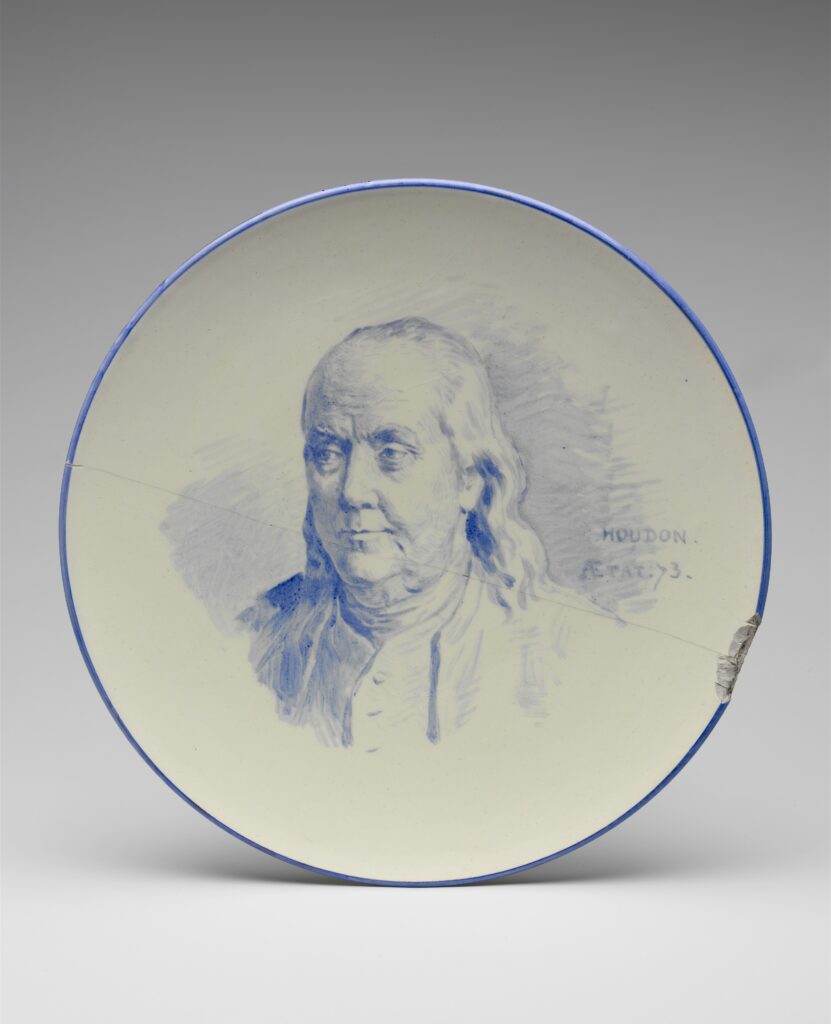
Dupont-Zipcy (after Houdon), Plate of Benjamin Franklin (1776-1883)/ The Metropolitan Museum of Art
In 1778, France was the first country to officially recognize American independence. King Louis XVI welcomed Benjamin Franklin to the Palace of Versailles, where France and the young American republic signed the Treaty of Friendship, Commerce, and Alliance.
Franklin was unlike anyone the French court had ever seen. While members of the aristocracy wore elaborate powdered wigs and embroidered silk coats, Franklin arrived with his natural hair wearing simple clothing. He wanted to embody the ideals of a new republic, free from monarchy.
Parisians adored him. Franklin became something of an 18th-century celebrity. His portrait appeared on medallions, snuffboxes, and decorative objects throughout the city.
France Helps Win the American Revolution
The alliance between France and American revolutionaries was a turning point in the war. King Louis XVI sent more than 6,000 French troops under General Rochambeau to fight alongside George Washington. Their support proved decisive at the Battle of Yorktown in Virginia in 1781, where the British surrendered and the American Revolution was effectively won.
Two years later, in 1783, peace was officially signed in Paris. The Americans refused to sign the treaty at the British Embassy, so it was signed instead at the former Hôtel d’York at 65 Rue Jacob. Aside from an easily missed marble plaque about the Treaty of Paris on the stone facade, this townhouse looks like any other in the 6th arrondissement. Few visitors realize they are passing one of the sites which birthed the United States.
Lafayette: The Hero of Two Worlds

Washington and Lafayette at Mount Vernon, 1784/ The Metropolitan Museum of Art, New York
Still in his twenties, the Marquis de Lafayette sailed across the Atlantic to offer his services—without pay—to the Americans. During the Yorktown campaign in Virginia, he became one of the Revolution’s greatest heroes. He also secured vital support (men, ships, and funds) for the American cause.
Lafayette is remembered as “The Hero of Two Worlds” because when he returned to France, he brought those revolutionary ideals home. During the French Revolution, he helped draft the Declaration of the Rights of Man and of the Citizen, inspired in part by the American Declaration of Independence.
The Ideas That Crossed the Atlantic
The relationship between France and America wasn’t limited to war or diplomacy. The more fundamental exchanges were intellectual.
French philosopher Nicolas de Condorcet admired the American experiment and wrote about its importance for Europe. He also championed the abolition of slavery and women’s rights, making him one of the Enlightenment’s most progressive thinkers.
Another fascinating figure in the Franco-American relationship was Thomas Paine. Born in England, he became one of America’s Founding Fathers before later joining the French Revolution. Today, you can still see his gilded bronze statue in Parc Montsouris in southern Paris (Métro Line 4 to Porte d’Orléans or Mairie de Montrouge).
The Gift That Became America’s Symbol
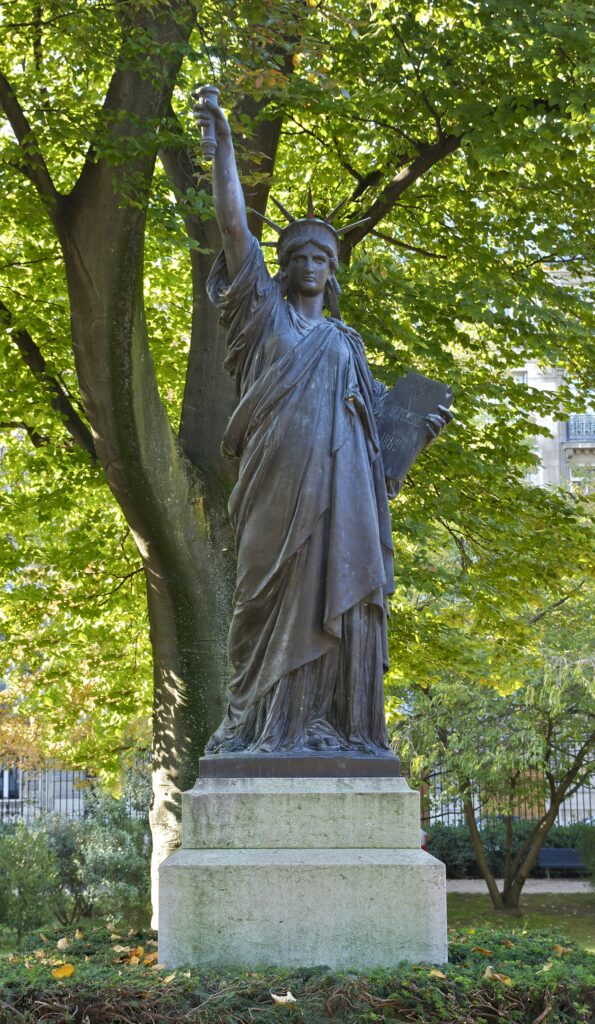
Statue of Liberty in the Luxembourg Gardens, Paris
Perhaps there’s no symbol of Franco-American friendship more celebrated than the Statue of Liberty.
The idea for the project originally came from French scholar Édouard Laboulaye, who wished to celebrate America’s upcoming centennial, the abolition of slavery, and the enduring ties between the two nations. Sculptor Frédéric Auguste Bartholdi took his concept and made it a reality. Gustave Eiffel engineered its internal structure. Before its 1886 unveiling in New York Harbor, Lady Liberty was imagined and constructed in Paris.
Unveiled in New York Harbor in 1886, she became one of the world’s most recognizable monuments. The broken shackle and chains at her feet are symbols for the end of the oppression that Laboulaye passionately championed.
Visitors to Paris are often surprised to discover that the city has several smaller versions of the Statue of Liberty. You can spot a 1/4 model version on the Seine, another in the Luxembourg Gardens, and even a copy inside the Musée d’Orsay. The always fascinating Musée des Arts et Métiers displays one of the original maquettes used by Bartholdi.
American Support for France’s Historic Sites
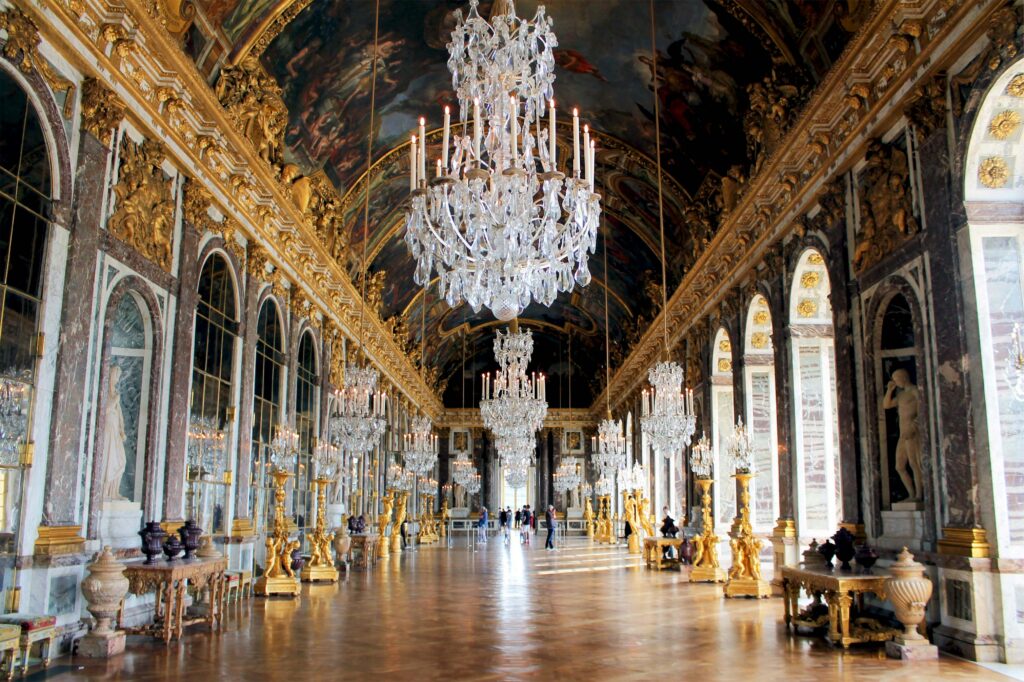
The Hall of Mirrors, Palace of Versailles
Since the Revolution, the alliance has flourished in many forms and through the work of countless individuals.
In 1924, philanthropist John D. Rockefeller Jr. donated an extraordinary one million dollars to help restore some of France’s greatest historic monuments, including the Palace of Versailles, Fontainebleau, and Reims Cathedral.
If you visit Versailles today, you’ll find a plaque near the Gabriel Staircase commemorating his remarkable generosity.
More recently, after the devastating fire at Notre-Dame Cathedral in 2019, Americans became the second-largest group of international donors supporting its restoration.
Tracing the Franco-American Story in Paris
To explore this remarkable history while visiting Paris:
- The Palace of Versailles, where Louis XVI officially recognized the United States in 1778.
- 56 Rue Jacob, where the Treaty of Paris ending the American Revolution was signed.
- The Musée d’Orsay, home to one of Paris’s original Statue of Liberty sculptures.
- Parc Montsouris, where you’ll find the statue of Thomas Paine.
- Les Invalides, whose museums tell the story of the two World Wars and the crucial role played by American forces in the liberation of France.
More than two centuries after Benjamin Franklin first captivated Paris, the friendship between France and the United States remains visible throughout the city. Whether you’re visiting Versailles, admiring one of the city’s Statue of Liberty, or walking past the house where the Treaty of Paris was signed, you’re following the traces of one of history’s most enduring partnerships.